Tata Cara Tawaf Wada – Complete Guide, Meaning, Ruling & Step-by-Step Instructions
Leaving Makkah after completing Hajj is one of the most emotional moments in a believer’s life. After days filled with worship, tears, and powerful memories, the time comes to say goodbye to the Sacred House. Standing before the Kaaba for the final time, many hearts feel both gratitude and sadness. This final act of devotion is known as Tawaf Wada — the Farewell Tawaf.
Table of Contents
Many pilgrims search for tata cara tawaf wada because they want to make sure they perform this farewell correctly. At the same time, others ask what tawaf wada adalah, or what exactly Tawaf Wada means and why it is required. Is it a pillar of Hajj? Is it obligatory for everyone? When should it be performed? These are common questions that often cause confusion among first-time pilgrims.
Understanding the ruling and proper method of Tawaf Wada is important, as it is meant to be the final act before leaving Makkah. Making mistakes in timing or procedure can lead to uncertainty about whether it was performed correctly.
In this guide, you will find a clear and simple explanation of tata cara tawaf wada, including its meaning, ruling, correct timing, and step-by-step instructions. Everything is presented in an easy-to-understand and authentic way, so you can perform your Farewell Tawaf with confidence, peace, and sincerity.
Tawaf Wada Adalah – What Does It Mean?
Before learning the tata cara tawaf wada, it is important to clearly understand its meaning and purpose.
Tawaf Wada Adalah (Definition)
Tawaf wada adalah the Farewell Tawaf performed by pilgrims before leaving Makkah after completing Hajj. The word “wada” means farewell, indicating that this Tawaf serves as a final goodbye to the Kaaba.
It is performed after completing all the main rituals of Hajj, including Tawaf al-Ifadah, Sa’i (if required), staying in Mina, and the stoning of the Jamarat. Only once the pilgrim has finished the essential rites of Hajj should Tawaf Wada be performed.
It is important not to confuse Tawaf Wada with Tawaf al-Ifadah. Tawaf al-Ifadah is a pillar (rukun) of Hajj and must be completed for Hajj to be valid. Tawaf Wada, on the other hand, is not a pillar but is considered obligatory (wajib) for most pilgrims. The two Tawaf have different timings and rulings.
Understanding that tawaf wada adalah a farewell act helps pilgrims appreciate its emotional and spiritual importance.
Evidence from Hadith
The obligation of Tawaf Wada is based on authentic narrations from the Prophet ﷺ. He instructed that pilgrims should not leave Makkah until they have made Tawaf their final act at the Sacred House.
In a well-known narration, it was reported that people were ordered to make the last thing they do before leaving Makkah to be Tawaf around the Kaaba, except for women who were menstruating, who were excused.
This hadith forms the foundation for the ruling and explains why scholars consider Tawaf Wada obligatory for non-residents of Makkah.
Purpose and Wisdom Behind Tawaf Wada
Tawaf Wada carries deep meaning beyond its legal ruling.
First, it is a way of honoring the Sacred House of Allah. Just as a guest greets the host upon arrival, it is respectful to bid farewell before departing.
Second, it ensures that Hajj is completed properly. By performing Tawaf Wada as the final act, the pilgrimage concludes in worship and remembrance of Allah.
Finally, it serves as a spiritual farewell. Standing before the Kaaba one last time often brings tears and reflection. It is a moment of gratitude, humility, and hope — hope that Allah accepts the pilgrimage and grants the opportunity to return again.
Ruling of Tawaf Wada
Understanding the ruling is essential before learning the full tata cara tawaf wada. Many pilgrims ask whether it is compulsory and who exactly must perform it.
Is Tawaf Wada Obligatory?
According to the majority of Islamic scholars, Tawaf Wada is wajib (obligatory) for pilgrims who are not residents of Makkah. This ruling is based on authentic hadith in which the Prophet ﷺ instructed pilgrims to make Tawaf their final act before leaving.
However, it is important to clarify that Tawaf Wada is not a pillar (rukun) of Hajj. This means that Hajj remains valid without it, but leaving it intentionally requires compensation (such as offering a sacrifice). So while it is not a foundational pillar like Tawaf al-Ifadah, it is still mandatory for most pilgrims.
Understanding this distinction helps avoid confusion about its importance.
Who Must Perform It?
Tawaf Wada must be performed by pilgrims who are not residents of Makkah. Any Hajj pilgrim traveling from outside Makkah is required to complete this farewell Tawaf before departing the city.
It should be the last act done in Makkah before travel, marking the official conclusion of the pilgrimage.
Who Is Exempt?
Certain individuals are excused from performing Tawaf Wada:
- Women who are menstruating or experiencing postnatal bleeding are exempt and do not need to perform it. There is no penalty upon them.
- Residents of Makkah are also not required to perform Tawaf Wada, since they are not leaving the city after Hajj.
Knowing who is obligated and who is exempt ensures that the tata cara tawaf wada is followed correctly according to Islamic guidance.
Tata Cara Tawaf Wada (Step-by-Step Guide)
Understanding the tata cara tawaf wada is important to ensure this farewell act is performed correctly and confidently. The steps are similar to regular Tawaf, but the intention and timing make it special — it is the final act before leaving Makkah.
Step 1 – Make Intention (Niyyah)
The first step in the tata cara tawaf wada is making a sincere intention in your heart. Intend that you are performing Tawaf Wada as your farewell Tawaf before departing Makkah.
There is no need to say the intention aloud. Simply form the intention internally with sincerity and awareness. What matters most is that you are performing it for the sake of Allah as the closing act of your Hajj.
Step 2 – Start at the Black Stone
Begin at Hajar al-Aswad, the Black Stone located at one corner of the Kaaba.
- Face Hajar al-Aswad.
- Say: “Bismillah, Allahu Akbar.”
- If possible, you may touch or kiss it.
If the area is crowded, simply raise your right hand toward it and say “Allahu Akbar.” Do not push or harm others. Pointing from a distance is completely valid.
This marks the start of your first round.
Step 3 – Complete Seven Rounds
Walk in a counterclockwise direction, keeping the Kaaba on your left side at all times.
You must complete seven full rounds. Each time you return to the Black Stone, one round is completed. Move calmly and avoid rushing. Maintaining patience and respect for others is an important part of proper worship.
The movement in the tata cara tawaf wada is identical to any standard Tawaf — the difference lies in its purpose as a farewell.
Step 4 – What to Recite During Tawaf
There is no specific required dua for Tawaf Wada. You may recite verses from the Quran, make dhikr (such as SubhanAllah, Alhamdulillah, Allahu Akbar), or offer personal supplications in any language.
Between Rukn Yamani and the Black Stone, it is recommended to recite:
“Rabbana atina fid-dunya hasanah wa fil-akhirati hasanah wa qina ‘adhaban-nar.”
Apart from this, you are free to make sincere dua from your heart.
Step 5 – Pray Two Rak’ah After Tawaf
After completing seven rounds, pray two Rak’ah.
It is recommended to pray behind Maqam Ibrahim if space allows. If the area is crowded, you may pray anywhere inside Masjid al-Haram.
With this final prayer, the tata cara tawaf wada is complete, marking the emotional and spiritual conclusion of your time in Makkah.
When Should Tawaf Wada Be Performed?
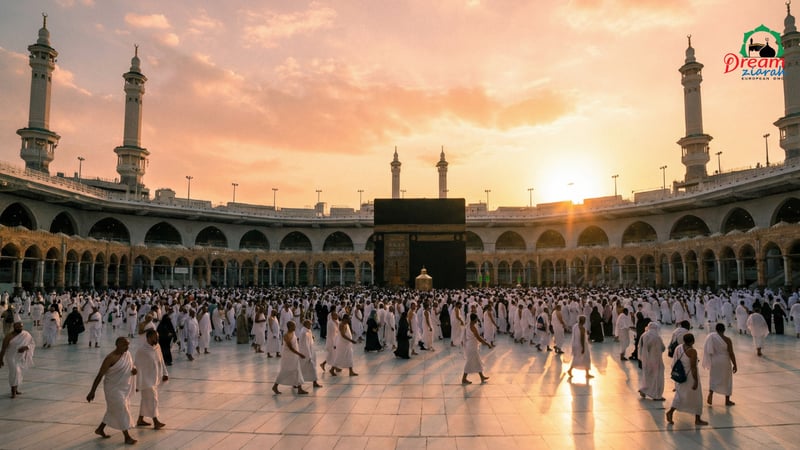
Understanding the correct timing is an essential part of the tata cara tawaf wada. Since this Tawaf is meant to be a farewell, its timing is directly connected to your departure from Makkah.
Correct Timing
Tawaf Wada must be performed after completing all Hajj rituals. This includes finishing Tawaf al-Ifadah, Sa’i (if required), the days in Mina, and the stoning of the Jamarat. Only once everything else is completed should you prepare for the Farewell Tawaf.
It should be done immediately before leaving Makkah. The purpose of Tawaf Wada is to ensure that your final act in the city is worship at the Sacred House. After completing it, your intention should be to depart.
Making Tawaf Wada too early — while still planning to remain in Makkah for an extended period — goes against its purpose as a farewell.
Can You Shop or Rest After Tawaf Wada?
Minor necessary activities are allowed after performing Tawaf Wada. For example, you may:
- Collect your luggage
- Wait for transportation
- Eat or rest briefly
- Purchase small essential items
However, you should not delay your departure unnecessarily. Spending long hours shopping or staying in Makkah without a valid reason after Tawaf Wada contradicts its meaning as the final act before leaving.
In short, once the tata cara tawaf wada is completed, the pilgrim should prepare to depart with gratitude, reflection, and hope that Allah accepts their Hajj.
What Happens If Someone Misses Tawaf Wada?
Understanding the consequences of missing Tawaf Wada is important when learning the full tata cara tawaf wada. Since it is considered wajib (obligatory) for non-residents of Makkah, leaving it without a valid excuse has specific rulings.
Ruling on Leaving Without It
If a pilgrim who is required to perform Tawaf Wada leaves Makkah without completing it, the majority of scholars state that a sacrifice (dam) becomes necessary. This usually involves arranging for an animal to be sacrificed in Makkah, and the meat is distributed to the poor.
Although Tawaf Wada is not a pillar (rukun) of Hajj, neglecting it without a valid reason requires compensation. The Hajj itself remains valid, but the pilgrim must fulfill this obligation.
This ruling highlights the importance of correctly following the tata cara tawaf wada before departure.
What If Someone Forgets?
If someone forgets to perform Tawaf Wada and remembers shortly after leaving Makkah, scholars generally advise returning to perform it if possible.
If returning is not possible due to distance or travel constraints, then offering the required sacrifice (dam) becomes necessary according to the majority opinion.
However, women who are menstruating or experiencing postnatal bleeding are completely exempt and do not need to offer any compensation.
Because individual situations may vary, it is always best to consult a qualified scholar for personal guidance.
Difference Between Tawaf Wada and Tawaf Ifadah
Many pilgrims confuse Tawaf Wada with Tawaf al-Ifadah. While both involve circling the Kaaba seven times, they differ in timing, ruling, and purpose. Understanding this distinction is essential when learning the correct tata cara tawaf wada.
Difference in Timing
Tawaf al-Ifadah is performed during the days of Hajj, specifically after returning from Mina on the 10th of Dhul-Hijjah (after stoning Jamarat and sacrifice). It is one of the main rituals of Hajj and must be completed during the designated time.
Tawaf Wada, on the other hand, is performed at the very end of the pilgrimage. It is done after completing all Hajj rituals and immediately before leaving Makkah. It serves as the final act before departure.
Difference in Ruling
The ruling of each Tawaf is different.
Tawaf al-Ifadah is a pillar (rukun) of Hajj. Without it, Hajj is not valid.
Tawaf Wada is not a pillar but is considered wajib (obligatory) for pilgrims who are not residents of Makkah. If missed without excuse, a sacrifice (dam) is required, but Hajj remains valid.
This distinction helps clarify why proper understanding of the tata cara tawaf wada is still very important, even though it is not a pillar.
Difference in Purpose
The purpose of Tawaf al-Ifadah is to fulfill a core obligation of Hajj. It marks a major stage in completing the pilgrimage.
The purpose of Tawaf Wada is to serve as a spiritual farewell. It ensures that the final action before leaving Makkah is an act of worship at the Sacred House. It is a moment of gratitude, reflection, and emotional goodbye.
In summary, while both are forms of Tawaf, their timing, ruling, and purpose clearly distinguish them.
Common Mistakes During Tawaf Wada
One common mistake during the tata cara tawaf wada is thinking that Tawaf Wada is a pillar (rukun) of Hajj. In reality, it is wajib (obligatory) for non-residents of Makkah but not a pillar. This means Hajj remains valid without it, although compensation (dam) may be required if it is missed without excuse. Confusing it with Tawaf al-Ifadah often causes unnecessary fear and misunderstanding.
Another mistake is not making Tawaf Wada the final act before leaving Makkah. Some pilgrims perform it and then spend many hours shopping or visiting places without necessity. Since Tawaf Wada is meant to be a farewell, it should be done immediately before departure, with only minor necessary tasks allowed afterward.
Rushing through Tawaf Wada without focus is also a common error. Because pilgrims are preparing for travel, they may complete the seven rounds quickly without reflection. However, this is the last moment at the Sacred House, and it deserves calmness, humility, and sincere dua.
Finally, many believe that specific long supplications must be recited during Tawaf Wada. In fact, there is no required fixed dua. You may recite Quran, make dhikr, or offer personal supplications in your own language. Understanding this helps you follow the tata cara tawaf wada correctly without unnecessary stress.
Conclusion:
Completing the tata cara tawaf wada is often one of the most emotional moments of the entire Hajj journey. As a pilgrim circles the Kaaba for the final time, the heart feels both gratitude and sadness. This farewell Tawaf is not just a ritual — it is a quiet goodbye to the Sacred House that has witnessed tears, prayers, and sincere repentance. Understanding that tawaf wada adalah the final act before leaving Makkah makes the moment even more meaningful.
After days of worship, sacrifice, and devotion, Tawaf Wada becomes a symbol of completion. It is a chance to thank Allah for granting the opportunity to perform Hajj and to ask that every effort be accepted. Performing the tata cara tawaf wada with sincerity allows a believer to leave Makkah with peace in the heart and hope in the soul.
As the pilgrim walks away from the Kaaba, there is often a silent prayer: the hope of returning again. Knowing that tawaf wada adalah a farewell does not mean it is the end — rather, it is a reminder that the connection with Allah continues wherever one goes. The journey may conclude physically, but spiritually, it leaves a lasting imprint on the heart.
No Latest Posts Found