Mataf Area: Meaning, Location, and Importance Around the Kaaba
The Mataf Area is one of the most sacred spaces within Masjid al-Haram in Makkah, surrounding the holy Kaaba, the spiritual center of Islam. This open area forms the path where millions of Muslims gather to perform Tawaf, the ritual of walking seven times around the Kaaba as an act of worship. Because of its direct connection to this important ritual, the Mataf Area holds a central place in the spiritual experience of pilgrims visiting the Grand Mosque.
Table of Contents
In simple terms, the Mataf Area refers to the space around the Kaaba where Tawaf takes place. Pilgrims move in a circular path within this area, beginning and ending their Tawaf at the corner where Hajar al-Aswad (the Black Stone) is located. The constant movement of believers around the Kaaba in the Mataf Area symbolizes unity, devotion, and submission to Allah.
The Mataf Area is considered one of the most sacred locations in Islam because it surrounds the Kaaba, the direction toward which Muslims around the world face during their daily prayers. For centuries, this space has been filled with worshippers performing Tawaf, offering prayers, and reflecting on their faith.
During the seasons of Hajj and Umrah, the Mataf Area becomes the heart of pilgrimage activities in Makkah. Pilgrims from every part of the world gather here to perform Tawaf, making it one of the most spiritually significant and emotionally powerful places for Muslims visiting the holy city.
What Is the Mataf Area?
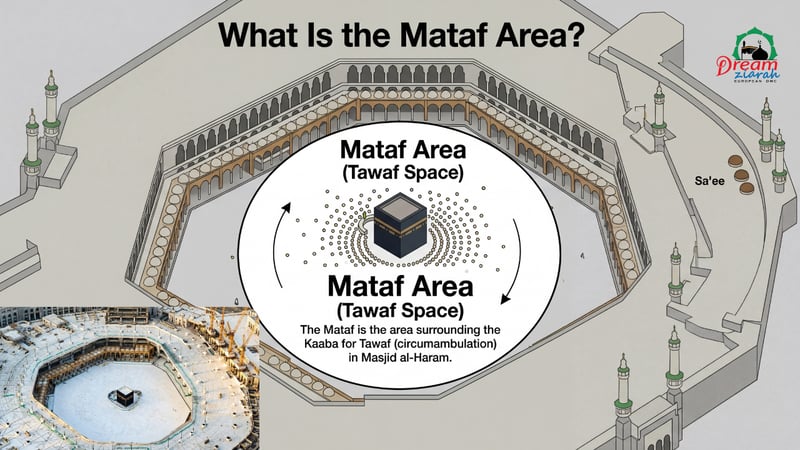
The Mataf Area refers to the open space surrounding the Kaaba inside Masjid al-Haram in Makkah, where pilgrims perform the ritual of Tawaf. This area forms the circular path that worshippers follow as they walk around the Kaaba during Hajj and Umrah. For millions of Muslims visiting the Grand Mosque each year, the Mataf Area becomes the central place where they carry out one of the most important acts of pilgrimage.
The word “Mataf” comes from the Arabic root ṭāfa, which means to circle or to walk around something. Therefore, the Mataf Area literally means “the place of circumambulation.” It is specifically designed as the space where pilgrims move in a circular direction around the Kaaba while performing Tawaf.
During Tawaf, pilgrims walk seven times around the Kaaba, starting from the corner where Hajar al-Aswad (the Black Stone) is located. As they move through the Mataf Area, worshippers often recite prayers, make supplications, and reflect on their faith. The movement of thousands of believers around the Kaaba in the Mataf Area symbolizes unity and devotion to Allah.
Key Points About the Mataf Area
- Open space surrounding the Kaaba: The Mataf Area forms the circular courtyard around the Kaaba inside the Grand Mosque.
-
Used for the Tawaf ritual: Pilgrims perform seven rounds around the Kaaba in this space during Hajj and Umrah.
- Located inside Masjid al-Haram: The Mataf Area is part of the central courtyard of the sacred mosque in Makkah.
Where Is the Mataf Area Located?
The Mataf Area is located in the central courtyard of Masjid al-Haram in Makkah, directly surrounding the Kaaba, the most sacred structure in Islam. This open circular space forms the pathway where pilgrims perform Tawaf, walking around the Kaaba during Hajj and Umrah. Because the Kaaba stands at the center of the Grand Mosque, the Mataf Area naturally becomes the focal point of worship within Masjid al-Haram.
The Mataf Area completely surrounds the Kaaba, creating a large open space where thousands of pilgrims can move continuously in a circular direction. From above, the Mataf appears as a wide courtyard with the Kaaba positioned at its center, while worshippers flow around it in organized circles during Tawaf.
Situated within the central courtyard of Masjid al-Haram, the Mataf Area connects to various sections of the mosque, including prayer halls, upper floors, and entry corridors. This design allows pilgrims to easily reach the Mataf Area from different parts of the mosque.
Access to the Mataf Area
Pilgrims can access the Mataf Area through multiple entrances of Masjid al-Haram. These entrances connect the mosque’s interior prayer areas and outer courtyards directly to the Mataf space.
During busy pilgrimage seasons, the mosque authorities organize entry and exit routes to help manage the large number of worshippers. Pilgrims usually enter the Mataf Area through designated pathways and join the circular flow of Tawaf around the Kaaba. After completing their Tawaf, they exit the Mataf area through nearby corridors leading to the mosque’s prayer halls or surrounding courtyards.
History of the Mataf Area
The Mataf Area has a long and rich history connected to the development of the Kaaba and Masjid al-Haram in Makkah. Over centuries, this sacred space has evolved to accommodate the growing number of pilgrims who come to perform Tawaf during Hajj and Umrah. While its spiritual purpose has remained the same, the physical size and design of the Mataf Area have expanded to support millions of worshippers.
Early Mataf Around the Kaaba
The practice of Tawaf in the Mataf Area dates back t
o the time of Prophet Ibrahim (Abraham) and his son Prophet Ismail (Ishmael). According to Islamic tradition, when they rebuilt the Kaaba by the command of Allah, the area surrounding the Kaaba became the place where believers would circle the sacred house in worship.
For generations, pilgrims visited Makkah and performed Tawaf around the Kaaba in this open space. Although the Mataf Area was much smaller in earlier times, it already held great spiritual significance as the central location for circumambulation.
Expansion of Masjid al-Haram
As the number of Muslims increased over the centuries, the need to expand Masjid al-Haram became more important. Various Islamic rulers and governments carried out construction projects to enlarge the mosque and improve facilities for pilgrims.
These expansions gradually increased the size of the Mataf Area, allowing more worshippers to perform Tawaf safely and comfortably. New courtyards, prayer halls, and pathways were added around the Kaaba to manage the growing crowds visiting Makkah.
Modern Mataf Expansion
In recent decades, large-scale development projects have significantly improved the Mataf Area. Modern expansions were designed to increase the capacity for Tawaf and support the millions of pilgrims who visit Masjid al-Haram every year.
These projects introduced wider walking spaces, improved marble flooring, and better crowd management systems. Additional levels of the mosque also allow pilgrims to perform Tawaf on upper floors when the ground-level Mataf becomes crowded.
Through these developments, the Mataf Area has evolved from a simple open space around the Kaaba into a carefully designed environment that continues to support one of the most important rituals in Islam while preserving its sacred spiritual purpose.
Importance of the Mataf Area in Tawaf
The Mataf Area plays a central role in Islamic worship because it is the place where pilgrims perform Tawaf around the Kaaba. Located within Masjid al-Haram, this sacred space becomes the pathway for one of the most important rituals in Hajj and Umrah. Every pilgrim who visits Makkah for these pilgrimages enters the Mataf Area to circle the Kaaba in devotion to Allah.
During Tawaf, pilgrims walk seven times around the Kaaba, moving in a counterclockwise direction within the Mataf Area. Each round begins and ends at the corner where Hajar al-Aswad (the Black Stone) is located. As they move through the Mataf Area, worshippers recite prayers, make supplications, and reflect on their faith. The continuous movement of thousands of believers around the Kaaba represents unity and submission to Allah.
The Mataf Area serves as the dedicated path for Tawaf, ensuring that pilgrims can move in an organized flow around the Kaaba. This space allows worshippers from all parts of the world to participate in the same sacred act of worship that has been practiced for centuries.
Tawaf itself is an essential ritual during Hajj and Umrah, making the Mataf Area one of the most important places inside Masjid al-Haram. The Qur’an refers to the Kaaba as a place where believers gather for worship and purification:
“And [mention] when We made the House a place of return for the people and a place of security… and purify My House for those who perform Tawaf.”
— Qur’an 2:125
This verse highlights the importance of the Kaaba and the practice of Tawaf, which takes place in the Mataf Area. For pilgrims visiting Makkah, walking through this sacred space becomes a powerful moment of devotion and spiritual connection.
Structure and Design of the Mataf Area
The Mataf Area is carefully designed to support the continuous movement of pilgrims performing Tawaf around the Kaaba inside Masjid al-Haram. Because millions of visitors come to Makkah each year for Hajj and Umrah, the structure of the Mataf Area has been developed to allow safe, organized, and smooth movement around the Kaaba while preserving the sacred atmosphere of the mosque.
One of the most noticeable features of the Mataf Area is its smooth white marble flooring that surrounds the Kaaba. The marble surface helps keep the ground cool even during hot weather and provides a comfortable walking path for pilgrims who perform Tawaf throughout the day and night.
The layout of the Mataf Area forms a circular movement path around the Kaaba. Pilgrims walk in a counterclockwise direction, creating a continuous flow of worshippers moving together around the sacred structure. This circular design allows thousands of people to perform Tawaf simultaneously while maintaining a steady and organized movement.
In recent years, the modern expansion of Masjid al-Haram introduced a multi-level Mataf design to accommodate the growing number of pilgrims. In addition to the ground-level Mataf surrounding the Kaaba, upper levels of the mosque now allow pilgrims to perform Tawaf when the lower level becomes crowded.
These structural improvements help the Mataf Area support large crowds safely and efficiently. Wide walking spaces, strong marble flooring, and multiple levels enable millions of pilgrims to perform Tawaf each year while maintaining the spiritual focus and dignity of worship inside the Grand Mosque.
Capacity of the Mataf Area
The Mataf Area is designed to accommodate a large number of pilgrims performing Tawaf around the Kaaba in Masjid al-Haram. As the number of visitors to Makkah has grown over the years, the capacity of the Mataf Area has increased through several expansion projects. These improvements ensure that millions of pilgrims can perform Tawaf safely and comfortably during Hajj and Umrah.
Pre-Expansion Capacity
Before major modern expansions, the Mataf Area was much smaller and could accommodate only a limited number of pilgrims at one time. Historical estimates suggest that the ground-level Mataf could host tens of thousands of worshippers per hour, but the space often became crowded during peak pilgrimage seasons.
Modern Capacity After Renovations
In recent decades, large-scale expansion projects in Masjid al-Haram significantly increased the capacity of the Mataf Area. These renovations widened the Tawaf path around the Kaaba and introduced additional levels where pilgrims can perform Tawaf.
Today, the modern Mataf Area can accommodate well over 100,000 pilgrims per hour across different levels of the mosque. The ground-level Mataf remains the most sought-after area because it is closest to the Kaaba, while upper levels help distribute the crowds during busy periods.
Crowd Management During Hajj
During the Hajj season, when millions of pilgrims gather in Makkah, careful crowd management is essential in the Mataf Area. Mosque authorities use organized pathways, designated entry and exit points, and guidance from security staff to maintain a smooth flow of movement around the Kaaba.
These systems help ensure that pilgrims can perform Tawaf safely while preserving the spiritual atmosphere of the Mataf Area, one of the most sacred spaces in Islam.
Rules and Etiquette in the Mataf Area
The Mataf Area is one of the most sacred spaces within Masjid al-Haram, where pilgrims perform Tawaf around the Kaaba. Because thousands of worshippers gather here at the same time, maintaining proper behavior and respect is essential. Islamic teachings encourage pilgrims to perform their acts of worship with humility, patience, and consideration for others.
One important guideline in the Mataf Area is to move with the natural flow of Tawaf. Pilgrims walk around the Kaaba in a continuous counterclockwise direction, and following this movement helps maintain an organized and safe environment. Staying within the flow allows everyone to perform Tawaf smoothly without unnecessary interruptions.
Pilgrims are also advised to avoid pushing, rushing, or blocking others. The Mataf Area can become crowded, especially during Hajj and busy Umrah seasons, so patience and kindness toward fellow worshippers are very important. Causing discomfort or forcing one's way through the crowd goes against the spirit of worship and respect expected in such a sacred place.
Another essential aspect of etiquette in the Mataf Area is to maintain humility and respect. Pilgrims are encouraged to focus on prayer, reflection, and remembrance of Allah while performing Tawaf. Speaking politely, helping others when needed, and maintaining calm behavior help preserve the peaceful and spiritual atmosphere of the Grand Mosque.
By following these simple guidelines, pilgrims contribute to a respectful environment where everyone can perform Tawaf safely and experience the spiritual significance of the Mataf Area.
Visiting the Mataf Area During Hajj and Umrah
For pilgrims visiting Masjid al-Haram in Makkah, the Mataf Area is the central place where they perform Tawaf around the Kaaba. During Hajj and Umrah, millions of worshippers gather in this sacred space, making proper planning and awareness important for a smooth and meaningful experience.
Best Time to Perform Tawaf
The Mataf Area can become very crowded, especially during peak pilgrimage seasons and around daily prayer times. Pilgrims who wish to perform Tawaf more comfortably often choose less crowded hours, such as late at night or early in the morning. During these times, the flow of worshippers is usually lighter, allowing pilgrims to move more easily around the Kaaba.
Access for Pilgrims
Pilgrims can access the Mataf Area from different parts of Masjid al-Haram. The most desired space is the ground-level Mataf, which is closest to the Kaaba and provides the most direct Tawaf experience.
However, when the ground-level area becomes crowded, pilgrims can also perform Tawaf on the upper floors of Masjid al-Haram. These additional levels help accommodate the large number of worshippers visiting the mosque and allow more people to perform Tawaf safely.
Safety Tips
Because the Mataf Area receives large crowds, following safety guidelines is important. Pilgrims should follow the instructions of mosque authorities and security staff, who help manage crowd movement and maintain safe pathways.
If traveling with family or a pilgrimage group, it is also helpful to stay together and agree on meeting points in case someone becomes separated. These simple precautions help ensure that pilgrims can focus on worship while moving safely within the Mataf Area.
Spiritual Significance of the Mataf Area
The Mataf Area is more than just the physical space surrounding the Kaaba in Masjid al-Haram. For Muslims, it represents one of the most spiritually powerful places on earth, where millions of believers gather to perform Tawaf and express their devotion to Allah. The experience of walking around the Kaaba in the Mataf Area carries deep meaning that connects faith, history, and the global Muslim community.
One of the most powerful aspects of the Mataf Area is the unity it represents among Muslims worldwide. Pilgrims from every country, culture, and language stand side by side while performing Tawaf. Despite their differences, they move together in the same direction around the Kaaba, reflecting the unity of believers in their worship of Allah.
The Mataf Area also represents a connection to centuries of Islamic worship. Since the time of Prophet Ibrahim (Abraham), believers have gathered around the Kaaba to perform Tawaf. Generations of Muslims throughout history have walked through this same sacred space, making the Mataf Area a living symbol of continuity in Islamic devotion.
For many pilgrims, performing Tawaf in the Mataf Area becomes an emotional and unforgettable moment. As they walk around the Kaaba, worshippers often feel a deep sense of humility, gratitude, and closeness to Allah. Surrounded by thousands of believers engaged in the same act of worship, the experience creates a powerful spiritual atmosphere that leaves a lasting impression on the hearts of pilgrims visiting Makkah.
Conclusion
The Mataf Area is the sacred space surrounding the Kaaba inside Masjid al-Haram in Makkah, where pilgrims perform the important ritual of Tawaf. This open courtyard forms the circular path that worshippers follow as they walk seven times around the Kaaba during Hajj and Umrah. Because Tawaf is one of the most significant acts of worship in Islam, the Mataf Area holds a central place in the spiritual life of Muslims who visit the holy city.
Within the Mataf Area, pilgrims move together in a continuous flow around the Kaaba, beginning and ending their Tawaf at the corner where Hajar al-Aswad (the Black Stone) is located. Each round represents devotion, remembrance of Allah, and a deep spiritual connection to the sacred house that has been the center of Islamic worship for centuries. The design of the Mataf allows thousands of believers to perform Tawaf at the same time, creating a powerful atmosphere of unity and faith.
For pilgrims visiting Makkah, entering the Mataf Area often becomes one of the most emotional moments of their journey. Standing close to the Kaaba and joining the flow of worshippers from around the world reminds believers of the shared faith that unites the global Muslim community. The experience of performing Tawaf in this sacred space brings feelings of humility, gratitude, and closeness to Allah.
The Mataf Area therefore represents much more than a physical courtyard around the Kaaba. It is the heart of worship inside Masjid al-Haram, a place where centuries of devotion continue as pilgrims gather to perform Tawaf and renew their faith while visiting the holy city of Makkah.
No Latest Posts Found